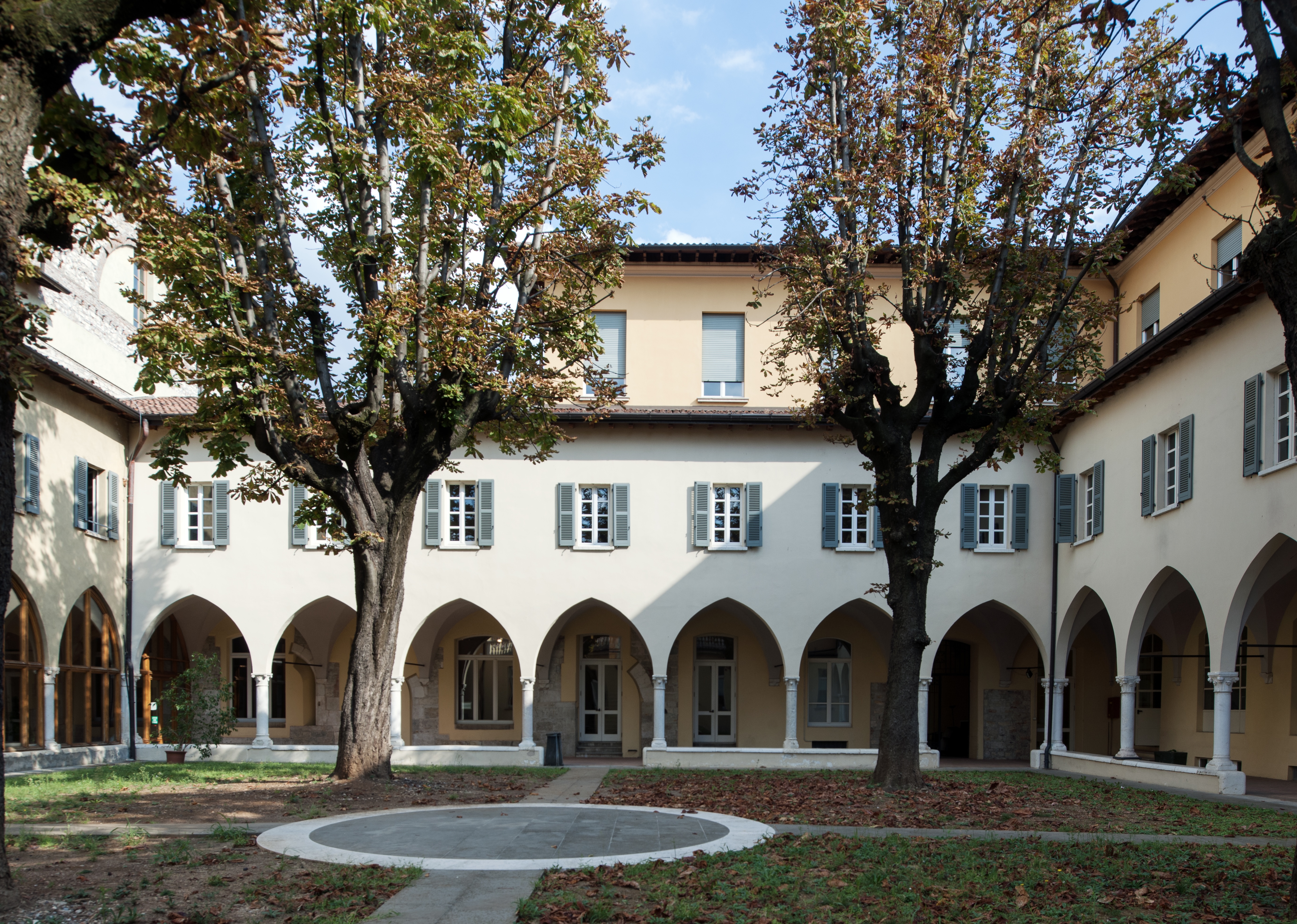
The history of the Conservatorio di Musica “Luca Marenzio” of Brescia is rooted in the Istituto Musicale “Venturi”, founded in the early years of the Italian nation state. In 1863, prominent Brescian citizens—Diogene Valotti, Gaetano Franchi, Costantino Quaranta, and Giovanni Consolini—promoted the creation of a private music school, supported by Carlo Antonio Venturi, a distinguished mycologist and amateur violinist. Venturi’s 1862 will endowed the Municipality of Brescia with the means to establish a philharmonic institution devoted to “a free school of music, of singing, and especially of bowed string instruments”. On 17 January 1864, twelve benefactors further financed the Filarmonica gratuita popolare; teaching began on 3 November 1864, inaugurating an uninterrupted musical and civic tradition. Associated with figures such as Antonio Bazzini, Isidoro Capitanio, Romano Romanini, Arturo Benedetti Michelangeli, Luigi Manenti, and Franco Margola, the institution became a major force in regional and national musical education. Its transformation into a State Conservatory was formalised by Law no. 663 of 8 August 1977, retroactive to 1 October 1971. In 1978, a second campus opened in Darfo Boario Terme, in the former Queriniano convent. The Conservatory was named after Luca Marenzio in 1993 and entered the AFAM system following Law no. 508 of 1999, a transition completed in 2005. Today, led by President Patrizia Vastapane and Director Massimo Cotroneo, it counts 113 teachers and over 1,000 students across seven departments, advanced academic pathways, teacher-training programmes, and three doctoral programmes. Its artistic life includes more than one hundred annual events, through Spazio Marenzio, the Concert Season, the Students’ Showcase, the STU.D.I.O. Orchestra, the Jazz Big Band, and the Marenzio Consort for historically informed performance.