Date
Online, November 4, 2025
Type
Interview
Biography
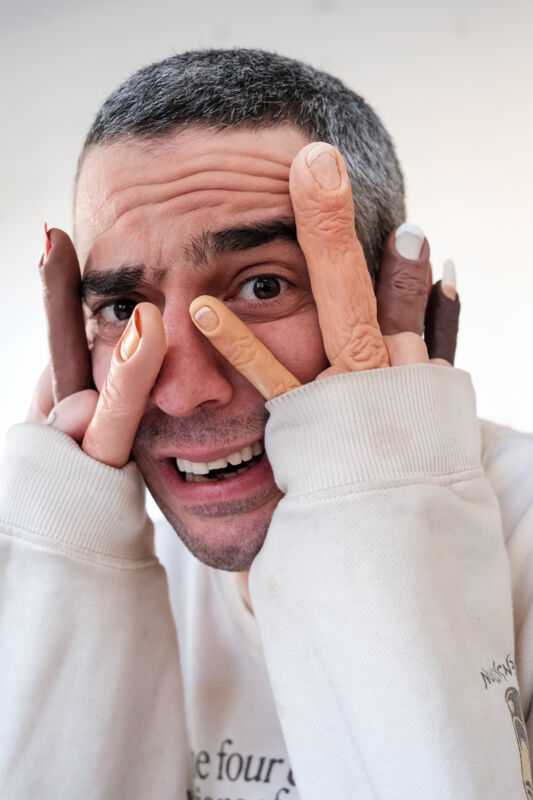
Federico Tosi (Milan, 1988) trained at the Brera Academy, where he earned a degree in painting and a master’s degree in sculpture, enriching his studies with a period at Mimar Sinan University in Istanbul. His research adopts a critical perspective on contemporaneity, outlining dystopian scenarios in which nature returns to exert a dominant force over humankind. His practice spans drawing, painting, and sculpture, employing resins, terracotta, cement, and mechanical devices. Since 2024, he has been teaching sculpture at the Liceo Artistico Giovanni XXIII in Milan.
Luca Esposito: If you had to describe the Academy with an image, which would you choose and why?
Federico Tosi: I attended the Academy about ten years ago, and it was a different place from what it is now. To me it felt like Hogwarts: these very tall, dilapidated corridors, with pigeons flying inside and students smoking. It felt like a castle. It was beautiful because entering Brera was like stepping into a time machine, into a nineteenth-century place in the heart of Milan. Yes, I would say the image is that of a time machine. Now that everything has been repainted, it has lost that charm.
L.E.: What were the most important lessons you received at the Academy?
F.T.: I received two types of teaching: one, from Alberto Garutti—historical professor of the painting chair, even though there was no actual painting—which was about developing a disposition toward the art world, with a methodology tied to exhibition practices and to taking care of space; the other, instead, taught me how to make things, through courses focused on techniques—sculpture, painting, printmaking. I essentially self-trained by making use of the spaces and materials that the Academy made available. Having taken these courses, however, I can say they were not all that useful: in the end I had to learn the techniques on my own. The spaces were there if you wanted them, but materials and tools were lacking, with the exception of the marble workshop and a few sculpture classrooms.
L.E.: What kind of relationship did you have with the Pinacoteca?
F.T.: I used to go there all the time. I took advantage of my free student access and would go up whenever I had the chance. Sometimes, before class at the Academy, I would grab a coffee and go in to take a close look at a painting. Today there’s this idea that, since a museum ticket costs €20, you have to see everything and stay inside for at least six hours: inevitably, when you come out, you end up hating art history. The great thing about being a student and having free access was that you could enjoy the museum whenever you wanted, even just going in to look again at a single painting. Among my favorite works is certainly the corridor with the portraits by Lorenzo Lotto: they are all there, looking at you and following you as you walk past them. Another image that brings me back to Hogwarts! The Pinacoteca was also useful for studying techniques: for example, when I had to create a sculpture in gold leaf representing a large dinosaur, I went to study how gold was used in the past, focusing in particular on the works of Lorenzo Lotto. I have always been struck by the fact that very few of us had this kind of interest in the museum, but for me going to see artworks and visiting exhibitions continues to be fundamental.
L.E.: Within your creative process, what kind of relationship exists between material and technique?
F.T.: As far as sculpture is concerned, I think that when you are doing research to create a work, when an idea comes to you and you begin to develop it, the material becomes the language through which you have to convey the poetry. Technique is the way in which you will write it. So I think that when ideas emerge, they already contain within them the material they need to be made with. Technique comes afterward, and if I don’t know it, I learn it.
L.E.: Have you ever delegated the production of your works?
F.T.: It is very difficult for me to delegate, but it has happened. For example, I delegated the casting of a bronze sculpture, but I was present until the very last stage: as soon as the bronze came out of the furnace and the chasing began, I was there. I also delegated the making of a large wooden sculpture because I didn’t have the means to produce it myself. In any case, it didn’t bother me.
L.E.: Given the importance you attribute to the material component, is there, in your research, a reflection on conservation?
F.T.: Yes, absolutely! In high school I studied conservation, and for that I have to thank my parents, who pushed me into it, because I wanted to focus on figurative art. Later, I happened to work for a few years for galleries as an installer, and I understood how important it was that the various parts composing a work were durable, comprehensible during installation, and capable of lasting over time. So these two elements—having studied conservation in high school and having worked as an installer—were extremely important for me, and led me to have a clear understanding, even before working as an artist, that the things I made should not break. For example, I made some drawings of galaxies and decided to produce them all on individual sheets, on A3 paper, which I then attached with acid-free tape. I chose to proceed in this way so that the sheets could be preserved individually and then, when needed, reassembled together. My experience as an installer also taught me to have great respect for this profession, so I try to create works that are easy to install, or at least accompanied by very clear instructions.
L.E.: If you were asked to describe your creative process through one of your works, which would you choose?
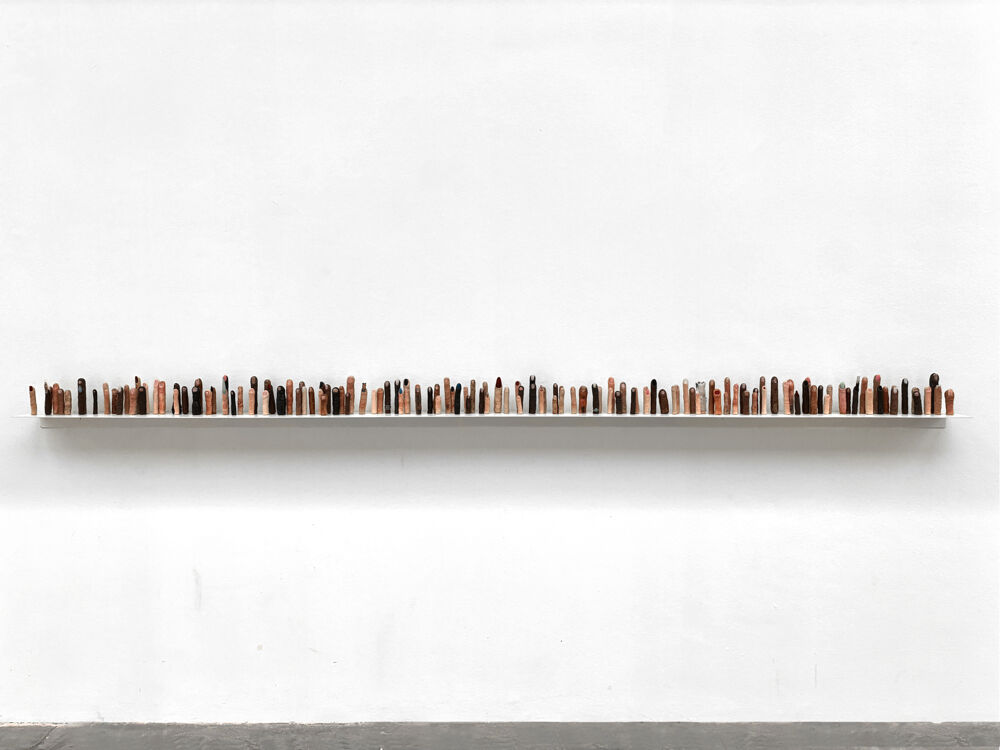
F.T.: I would like to tell you about Friends 2025, the work I recently presented at MAMbo, which consists of a shelf with a series of severed fingers placed on top. It is a work I am particularly attached to. The idea emerged during a research trip to the Philippines that lasted almost a year. I was in the middle of the jungle and conducted research on phototropism and on the behavior of certain root systems, on how roots move depending on the climate or the soil around them, finding many similarities with the way our neural structures behave. While I was exploring these aspects, I was also developing a project on bonsai, which I later presented in the exhibition Bonsai Riot at Monica De Cardenas, and for this theme of cutting, of controlling roots, we decided to also include the work on fingers. I would actually have liked to dedicate an entire exhibition to this piece, filling the gallery with fingers, but for various reasons we were unable to realize the project.
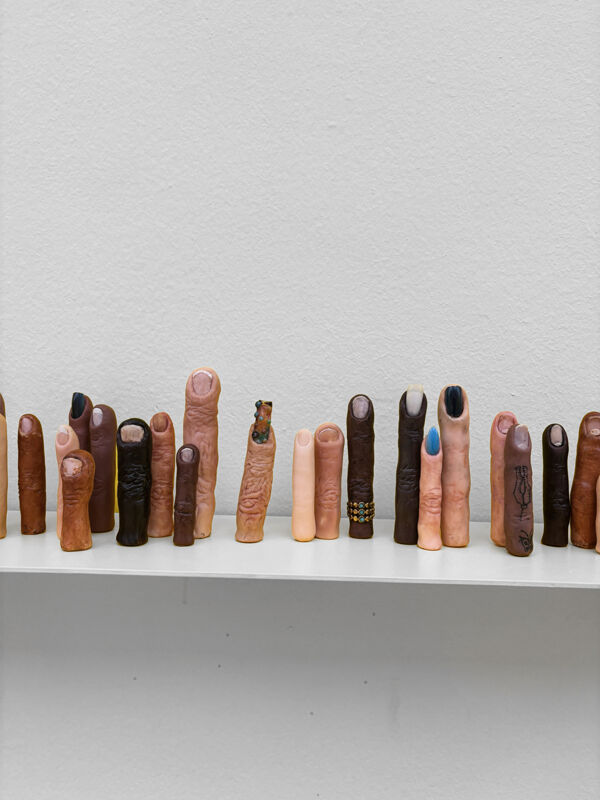
The fingers are made of thermosetting resin, Fimo, a modeling compound used for crafts, almost for children. Depending on how you work it, you can achieve different results, and I chose to bake them at higher temperatures than those recommended, making them much more resistant. I carried out real crash tests with these sculptures and they do not break even if you throw them forcefully onto the ground! To keep them upright, I used magnets, which, besides making installation easy, allows me to constantly change their position. It also facilitates transport, because the fingers are not fixed to the base and everything fits into a box. Beyond these aspects, which relate to my interest in material, Friends 2025 is a work that speaks about humanity and about being friends. I represented all the ethnic groups on the planet, trying to respect their proportions. Each individual finger was then personalized, thus representing a unique character and telling the story of the person who might be behind it. There are little fingers, thumbs—there are all of them: some I tattooed, others I had customized with very long nails by a friend who does nail art. I used the techniques employed in painting miniatures, which I learned when I was young painting toy soldiers—do you know Warhammer? From this sense of friendship that holds them together, what actually emerges is something very grotesque, something I had not initially anticipated: they are severed fingers, what remains of bodies whose whereabouts are no longer known. Integration and benevolence thus arrive at a moment of severance. A very dear friend of mine claims that in my exhibitions everyone always dies. If I look at my works, human beings never meet a good end. In Friends 2025, in order to speak about friendship and love among human beings, I had to present relics, as if they were severed trophies.
The fingers are made of thermosetting resin, Fimo, a modeling compound used for crafts, almost for children. Depending on how you work it, you can achieve different results, and I chose to bake them at higher temperatures than those recommended, making them much more resistant. I carried out real crash tests with these sculptures and they do not break even if you throw them forcefully onto the ground! To keep them upright, I used magnets, which, besides making installation easy, allows me to constantly change their position. It also facilitates transport, because the fingers are not fixed to the base and everything fits into a box. Beyond these aspects, which relate to my interest in material, Friends 2025 is a work that speaks about humanity and about being friends. I represented all the ethnic groups on the planet, trying to respect their proportions. Each individual finger was then personalized, thus representing a unique character and telling the story of the person who might be behind it. There are little fingers, thumbs—there are all of them: some I tattooed, others I had customized with very long nails by a friend who does nail art. I used the techniques employed in painting miniatures, which I learned when I was young painting toy soldiers—do you know Warhammer? From this sense of friendship that holds them together, what actually emerges is something very grotesque, something I had not initially anticipated: they are severed fingers, what remains of bodies whose whereabouts are no longer known. Integration and benevolence thus arrive at a moment of severance. A very dear friend of mine claims that in my exhibitions everyone always dies. If I look at my works, human beings never meet a good end. In Friends 2025, in order to speak about friendship and love among human beings, I had to present relics, as if they were severed trophies.
L.E.: From your research, there seems to be a particular attention to making works accessible to everyone: is this something that is already part of your creative process, or is it something you consider afterward?
F.T.: I think it comes first, I think it’s something innate—what an awful word! I was born and raised in the outskirts of Milan, in a very nice family but with no connection to the art world; as a result, I have never particularly liked it when forms of language are made too complex, becoming elitist. I don’t give a damn about the elite! I care about humanity. I am more interested in vulnerability than in indestructibility, and this leads me to be very clear in my narratives. Behind this choice there is certainly a political component, because it matters to me that anyone looking at my work can grasp it and then draw their own conclusions. But I’m not interested in elitist reasoning: you don’t have to have read three books by Donna Haraway to understand my work! You might have watched Melevisione, and that’s enough for me. I think this need comes from the context in which I grew up, a suburb where, at a certain point, even to be accepted as an artist—because I have always declared myself an artist since I was fifteen—I had to create something that everyone could understand. Even my rowdy friends hanging out on the benches had to get it, had to laugh or reflect. I don’t think I will ever change this aspect of my work. When I was studying with Alberto Garutti, this hyper-simplicity of mine was sometimes strongly criticized, and the work was described as didactic. I have reflected and worked a lot on this, because Garutti was right: it is one thing to say things clearly, another to be rhetorical. Finding the balance is not easy.
L.E.: What role do you give to words in presenting your works?
F.T.: Ideally, for me, there would be no press releases at my exhibitions. My work does not particularly need them. I would only want a list with the titles of the works. Titles interest me a lot; I like them because sometimes they provide a key to interpretation that, rather than making things univocal, opens them up. If I had called the work with the fingers “fingers” instead of “friends,” it would have been different. For GAMeC in Bergamo I had created a sculpture representing a large dolphin in terracotta, placed on a yellow pedestal, completely disemboweled and eaten by rats. Initially I had titled it Untitled. Rats and Dolphin. After a year, I wrote to the museum’s director asking to change the title, which is now Sapore di mare. I find it much more interesting.
L.E.: Looking back at your years at Brera, can you recognize in Friends 2025 a more or less explicit imprint of the teachings you received at the Academy?
F.T.: It makes me think of the issue of limited space and reduced budget. When I was studying at Brera, I had very little space, and so I began to conceive works in modules: many small elements that, when assembled, generate a larger one. And then there’s also the budget: the production cost of Friends 2025 is around €300, and the whole piece can be made on a small table with a simple kitchen oven. This ability to work with little space and little money certainly comes from my time at the Academy.